
STRATEGIC APPROACH
Our new strategy is in line with the United Nations Convention on the Rights of the Child (UNCRC) and United Nations General Assembly (UNGA) set guidelines on how care should be provided to children as depicted. OCV will achieve this through four pillars of delivery:
Our Four Pillars
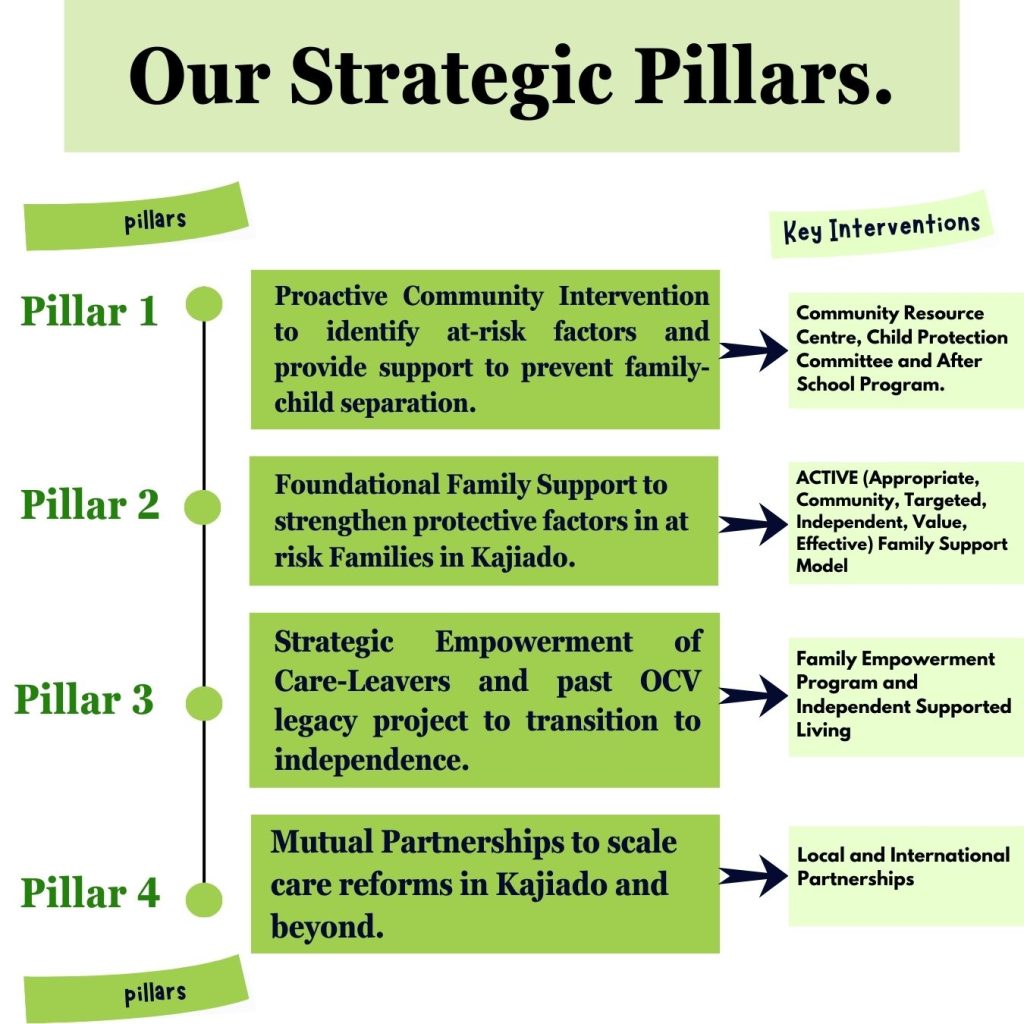
This pillar aims to empower the Olturoto community to actively identify, mitigate, and respond to child protection risks. It focuses on enhancing local capacity, promoting proactive community involvement, and establishing effective systems for early detection and intervention. The ultimate goal is to create a safer, more responsive, and engaged environment for children, thereby significantly reducing the risk of separation from their families.
Foundational Family Support aims to empower vulnerable families in the Olturoto community by enhancing household-level protective factors and preventing unnecessary child-family separations. Its core objective is to build resilience, promote positive parenting, and ensure consistent access to essential support services.
By addressing root causes such as economic hardship, limited parenting skills, low community engagement, and inadequate access to resources, this pillar delivers focused, family-level interventions that strengthen families and reduce the risk of separation.
Strategic Empowerment targets young people and families who are transitioning out of institutional care into independent or family-based living. Its main objective is to equip these individuals with essential life skills, educational support, emotional resilience, and economic self-sufficiency, ensuring that they successfully integrate into society without ongoing institutional dependence. By providing tailored support and structured interventions, this pillar aims to enable care leavers and reintegrating children to lead stable, fulfilling, and autonomous lives.
This pillar focuses on extending the impact of child protection efforts beyond OCV’s immediate reach by fostering strategic partnerships and collaborative engagement with key stakeholders, organizations, and community actors. It emphasizes the promotion of knowledge-sharing, advocacy, and mutual learning on best practices in deinstitutionalization, the shift to family-based care, and the strengthening of child protection systems.
Through the development of strong, coordinated partnerships, this initiative aims to influence policies, practices, and societal attitudes toward childcare reform, driving long-term, systemic improvements in child welfare and protection at both local and broader levels.